Canada continues to attract international students from Bangladesh and around the world, offering a wide range of academic programmes and opportunities to gain Canadian work experience. For students planning their finances, changes to provincial minimum wage rates are also worth understanding.
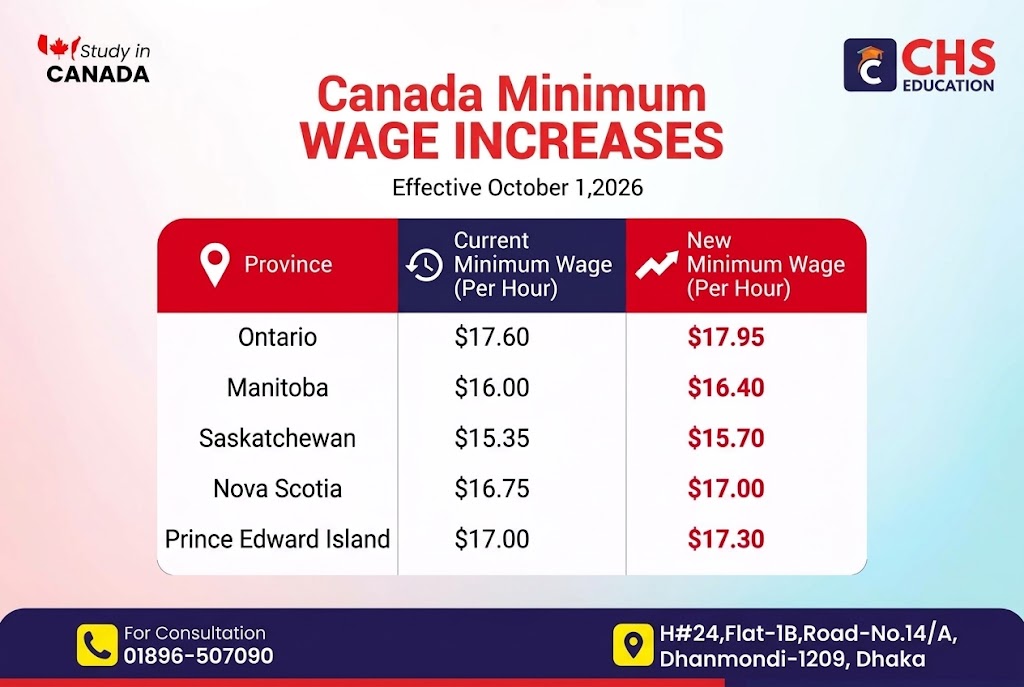
From October 1, 2026, several Canadian provinces will increase their general minimum wage rates. Ontario, Manitoba, Saskatchewan, Nova Scotia and Prince Edward Island are among the provinces making changes on this date. The figures shown in the CHS Education Limited infographic have been checked against the latest Canadian government information and are consistent with the published general minimum wage rates.
However, there is an important distinction for international students: minimum wage is the legal wage floor for eligible employees; it is not a guaranteed salary or guaranteed student income.
Actual earnings depend on the job, employer, location, skills, experience, working hours and individual eligibility.
Canada Minimum Wage 2026: What Is Changing?
Canada does not have one single minimum wage that applies to every employee across the country. Minimum wage rates are generally established by the province or territory, while federally regulated workplaces are subject to the federal minimum wage framework. Where applicable, the higher provincial or territorial rate applies.
Five provinces featured in our infographic are scheduled to increase their general minimum wage on October 1, 2026.
| Province | Previous Minimum Wage | New Minimum Wage | Increase |
|---|---|---|---|
| Ontario | $17.60 | $17.95/hour | $0.35 |
| Manitoba | $16.00 | $16.40/hour | $0.40 |
| Saskatchewan | $15.35 | $15.70/hour | $0.35 |
| Nova Scotia | $16.75 | $17.00/hour | $0.25 |
| Prince Edward Island | $17.00 | $17.30/hour | $0.30 |
These rates are confirmed through the Government of Canada's minimum wage database and the relevant provincial government sources.
What does "minimum wage" mean?
Minimum wage is generally the lowest legal hourly wage an employer can pay an employee covered by the applicable employment standards rules. It does not mean that all jobs pay exactly the minimum wage.
For example, a student working in a skilled, technical, administrative or professional position may receive a wage substantially above the applicable minimum.
Ontario Minimum Wage 2026
Ontario's general minimum wage will increase from $17.60 to $17.95 per hour on October 1, 2026. The increase is $0.35 per hour.
Ontario is a major destination for international students, with institutions and employment opportunities across communities such as Toronto, Ottawa, Waterloo and London.
For a student who obtains an eligible part-time job paid at exactly the general minimum wage, the higher hourly rate could increase gross earnings slightly.
However, students should not assume that they will automatically find a job or earn the general minimum wage. Employment depends on factors such as availability, qualifications, communication skills, previous experience, location and employer requirements.
A special point about Ontario's student minimum wage
Ontario also has a separate minimum wage for certain students under 18. From October 1, 2026, that rate will be $16.90 per hour. The provincial government specifies eligibility conditions for this special rate.
Therefore, the general Ontario rate of $17.95 should not be confused with every possible minimum-wage category.
Manitoba Minimum Wage 2026
Manitoba's general minimum wage will increase from $16.00 to $16.40 per hour on October 1, 2026. This represents a $0.40 hourly increase.
For international students considering Manitoba, minimum wage can be one part of the financial planning process.
Students should also consider tuition, accommodation, transportation, food and other living expenses before deciding how much employment income they may need.
The availability of part-time jobs can also vary depending on the student's city, programme schedule, experience and local employment market.
Saskatchewan Minimum Wage 2026
Saskatchewan's general minimum wage will increase from $15.35 to $15.70 per hour on October 1, 2026. The Saskatchewan government confirms both the existing and upcoming rates.
The increase is $0.35 per hour.
For students who find part-time employment at the minimum wage, this change could result in a modest increase in gross hourly earnings.
However, the minimum wage should be treated as a legal baseline rather than an expected student salary. Different jobs and employers can offer different rates.
Nova Scotia Minimum Wage 2026
Nova Scotia's general minimum wage is $16.75 per hour from April 1, 2026, and it is scheduled to increase to $17.00 per hour on October 1, 2026.
This represents an increase of $0.25 per hour.
Nova Scotia has different minimum wage orders for certain sectors, including construction/property maintenance and logging/forest operations. Therefore, the general rate should not automatically be assumed to apply to every occupation.
For students considering Nova Scotia, employment should be assessed alongside the cost of accommodation, transportation and other living expenses.
Prince Edward Island Minimum Wage 2026
Prince Edward Island's general minimum wage is $17.00 per hour and is scheduled to increase to $17.30 per hour on October 1, 2026. The province has also announced a further scheduled increase to $17.60 per hour on April 1, 2027.
The October 2026 increase represents $0.30 per hour.
The PEI government is continuing its annual minimum wage review, so future rates beyond the already announced increases may change following the applicable review process.
What Does the Minimum Wage Increase Mean for International Students?
For international students, a higher minimum wage can be useful—but it should be viewed as one element of a much larger financial plan.
1. Part-time employment
Eligible international students can work off campus while studying, subject to Canada's immigration requirements.
Under the current IRCC rules, eligible students can generally work up to 24 hours per week during regular academic sessions. During scheduled breaks that meet the applicable requirements, eligible students can work unlimited hours.
For example, if an eligible student worked 24 hours in one week at exactly the general minimum wage, the theoretical gross weekly earnings would be:
- Ontario: $430.80
- Manitoba: $393.60
- Saskatchewan: $376.80
- Nova Scotia: $408.00
- Prince Edward Island: $415.20
These figures are simply hourly-rate calculations. They are not a promise of employment or income.
A student may work fewer hours, earn more than the minimum wage, or be unable to find suitable employment.
2. Gross income is not take-home income
The hourly wage shown in a job advertisement is generally the gross wage.
The amount a student actually receives after applicable deductions may be lower because of taxes and other payroll deductions.
Therefore, students should avoid calculating their available monthly budget using gross wages alone.
3. Working hours may be limited
International students must comply with the conditions attached to their study permits and the applicable immigration regulations.
IRCC currently states that eligible students can work up to 24 hours per week off campus during regular school terms or semesters. Working more than the permitted limit can have immigration consequences.
Students should therefore plan their academic schedule carefully and prioritise their studies.
Can International Students Work While Studying in Canada?
Yes, eligible international students can work while studying in Canada, but eligibility conditions apply.
According to Immigration, Refugees and Citizenship Canada (IRCC), students who meet the requirements can generally work off campus without obtaining a separate work permit. Requirements include being enrolled at an eligible designated learning institution, having started the programme, holding an appropriate study permit and having a Social Insurance Number (SIN), among other conditions.
Students should also know that:
- They cannot start working before their study programme begins.
- They need a SIN to work.
- Certain types of programmes or student situations may not qualify for off-campus work.
- Students on an authorised leave may not be able to continue off-campus work.
- Students must keep track of their working hours.
- Immigration rules can change.
IRCC's official requirements should always be checked before making decisions about employment.
There are also separate rules concerning on-campus employment, and eligible students can generally work on campus without the same 24-hour weekly off-campus limit.
Minimum Wage vs Cost of Living in Canada
A higher hourly wage does not automatically mean that a student will experience lower financial pressure.
The overall cost of studying in Canada can include:
- Tuition fees
- Accommodation
- Food and groceries
- Public transportation
- Health and other insurance
- Mobile phone and internet
- Study materials
- Personal expenses
- Taxes and payroll deductions
The cost of these items can vary considerably depending on the province, city and individual lifestyle.
For this reason, students should avoid choosing a destination based solely on its minimum wage.
A province with a higher minimum wage may also have different accommodation or living costs, while employment opportunities may vary between cities and occupations.
Why Students Should Not Depend Entirely on Part-Time Work
Part-time employment can provide valuable work experience and supplementary income, but it should not normally be treated as the primary source of funding for an international student's entire education.
Before travelling to Canada, students and their families should prepare a realistic financial plan covering tuition and living expenses.
The Government of Canada requires study permit applicants to demonstrate that they have enough money to support themselves without working in Canada. This reinforces an important principle: part-time employment should be viewed as supplementary rather than as the foundation of a student's financial plan.
What Should Bangladeshi Students Consider Before Choosing a Canadian Province?
For students planning to study in Canada from Bangladesh, minimum wage is worth considering, but it should be one factor among several.
1. Tuition fees
Compare the complete tuition cost of your chosen programme and institution.
2. Accommodation
Research accommodation options and typical rental conditions in the city where you plan to study.
3. Employment opportunities
Consider the local employment market and whether part-time jobs are compatible with your academic schedule and skills.
4. Minimum wage
Understand the applicable provincial minimum wage, but do not treat it as guaranteed income.
5. Programme availability
The programme should fit your academic background, career interests and future plans.
6. Transportation
Consider how easily you can travel between your accommodation, campus and potential workplaces.
7. Weather and lifestyle
Canada has major differences in climate and lifestyle between provinces and communities. Students should consider which environment suits them.
8. Career planning
Look beyond part-time employment. Consider the career opportunities associated with your chosen programme and field.
9. Immigration rules
Canadian immigration policies can change. Eligibility for work permits, post-graduation work opportunities and other immigration pathways depends on the rules in force at the relevant time and the individual's circumstances.
No study-abroad consultant can legitimately guarantee a visa, job or permanent residence.
Final Takeaway: Canada Minimum Wage 2026
The October 1, 2026 minimum wage changes provide an important update for anyone researching employment and financial planning in Canada.
The verified general minimum wage rates are:
Ontario — $17.95/hour
Manitoba — $16.40/hour
Saskatchewan — $15.70/hour
Nova Scotia — $17.00/hour
Prince Edward Island — $17.30/hour
The figures in the original CHS Education Limited infographic are therefore consistent with the official rates currently published for these provinces.
For international students, however, minimum wage is only one part of the picture. Employment is not guaranteed, working hours can be restricted during academic terms, and actual take-home income will depend on taxes and other deductions.
Before choosing a Canadian study destination, students should consider tuition, accommodation, living expenses, employment opportunities, programme suitability, transportation, career plans and the latest immigration requirements.
Planning to Study in Canada from Bangladesh?
CHS Education Limited can help you understand your Canadian study options, admission requirements, documentation and application process.
Whether you are exploring undergraduate, postgraduate or other study opportunities, our team can help you understand the process and make an informed study plan.
Contact CHS Education Limited for professional guidance.
🌐 www.chseducation.com
📍 H#24, Flat 1/B, Road No;14/A, Dhanmondi, Dhaka-1209!
SEO Information
Primary Keyword:
Canada Minimum Wage 2026
Secondary Keywords:
- Canada minimum wage increase
- Canada student part-time jobs
- international students in Canada
- study in Canada from Bangladesh
- Canada student work opportunities
- minimum wage in Ontario 2026
- minimum wage in Manitoba 2026
- minimum wage in Saskatchewan 2026
- minimum wage in Nova Scotia 2026
- minimum wage in Prince Edward Island 2026
- Canada student work hours
- international student jobs in Canada
SEO Meta Title:
Canada Minimum Wage 2026: Student Guide
Meta Description:
Canada Minimum Wage 2026: See October wage changes and learn how minimum wage, student work rules and living costs affect international students.
URL Slug:canada-minimum-wage-2026-international-students
Frequently Asked Questions
What is the minimum wage in Canada in 2026?
Canada does not have one universal provincial minimum wage. Rates vary by province and territory, while federally regulated workplaces are subject to the federal minimum wage framework.
What is Ontario's minimum wage in October 2026?
Ontario's general minimum wage will be $17.95 per hour from October 1, 2026.
Can international students work part-time in Canada?
Eligible international students can generally work up to 24 hours per week off campus during regular academic sessions, subject to IRCC requirements.
Does every international student earn the minimum wage?
No. Minimum wage is a legal wage floor. Actual wages depend on the occupation, employer, location, qualifications and other factors.
Can students pay all their Canadian expenses through part-time work?
Students should not rely entirely on part-time employment to fund their education and living costs. Employment is not guaranteed, and eligible students face work-hour rules during regular academic sessions.
Official Sources
- Government of Canada — Current and Forthcoming General Minimum Wage Rates
- Government of Ontario — Minimum Wage
- Government of Manitoba — Employment Standards
- Government of Saskatchewan — Minimum Wage
- Government of Nova Scotia — Minimum Wage
- Government of Prince Edward Island — Minimum Wage Review 2026
- Government of Canada — Work Off Campus as an International Student
- Government of Canada — Work On Campus as an International Student
Fact-check status: September 26, 2026. The provincial rates above reflect the official information available at the time of publication. Immigration and employment rules can change, so students should verify the latest requirements with the relevant government authority before making decisions.