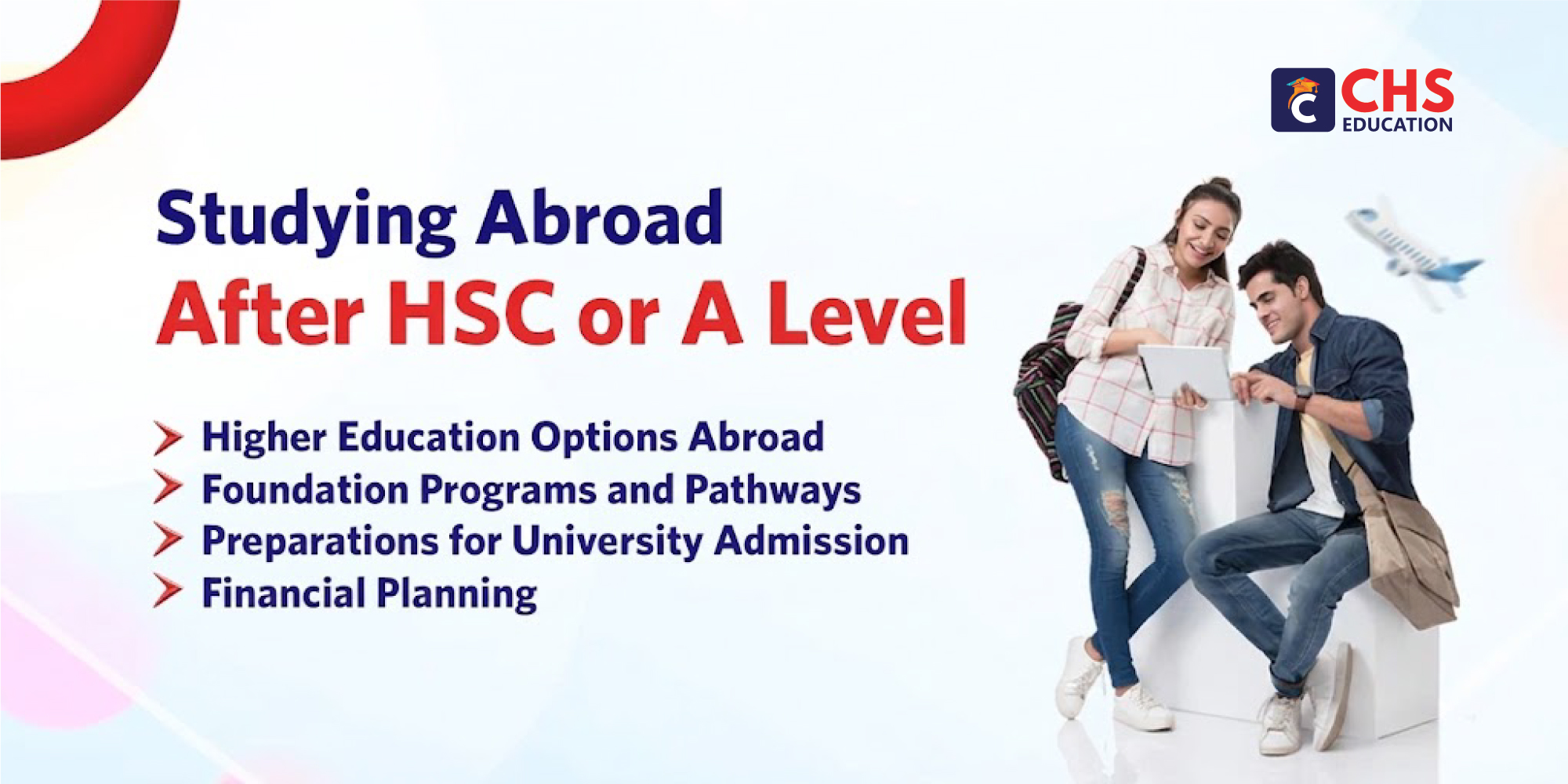
Completing your HSC or A Level is an important milestone -and for many Bangladeshi students, it is also the beginning of an exciting international education journey.
Studying abroad can open doors to globally recognised universities, diverse academic environments, international exposure and future career opportunities. However, choosing the right country, university and programme requires careful planning.
From university selection and foundation programmes to English proficiency, admission requirements, career planning and finances, there are several important steps to consider before starting your journey.
In this guide, CHS Education Limited explores the key options and preparations for students who want to study abroad after HSC or A Level.
Higher Education Options Abroad
Students today have access to a wide range of universities and programmes across different countries. Popular study destinations include the UK, USA, Australia, Sweden, Malaysia, Finland and Ireland.
The right destination depends on several factors, including:
- Your academic background
- Preferred subject or career
- University entry requirements
- Tuition and living costs
- English language requirements
- Scholarship opportunities
- Future academic and career plans
Study in the UK
The UK remains a popular destination for international students, offering a wide range of undergraduate programmes and universities.
Examples of universities included in the supplied source are:
- University of Oxford
- University of Cambridge
- University of Edinburgh
- University of Sheffield
- University of Warwick
- Newcastle University
- University of Liverpool
- Cardiff University
- University of Surrey
- University of Strathclyde
- Northumbria University
- Coventry University
- University of Greenwich
- University of Roehampton
- University of Salford
- University of Westminster
- University of Sunderland
Students should always check the specific entry requirements for their chosen programme before applying.
Study in the USA
The USA offers a broad selection of undergraduate programmes across public and private universities.
The supplied source highlights institutions such as:
- Towson University
- University of Nebraska at Omaha
- James Madison University
- Lipscomb University
- University of Hartford
- DePaul University
- Florida Atlantic University
- Long Island University
- Texas A&M University-Corpus Christi
- California State University San Marcos
Depending on the university and programme, students may need to meet specific academic and standardised testing requirements.
Study in Australia
Australia is another popular destination for international students seeking undergraduate education.
Universities listed in the source include:
- Monash University
- Griffith University
- Charles Sturt University
- University of Canberra
- University of Newcastle
- University of Technology Sydney (UTS)
- Curtin University
- University of Tasmania
- University of Sydney
- University of Melbourne
- Australian National University
- The University of Queensland
- University of Adelaide
Study in Malaysia
Malaysia can be an attractive option for students looking for internationally oriented education in Asia.
The source includes:
- Taylor’s University
- HELP University
- University of Malaya
- SEGi University
- IMU University
- Asia Pacific University of Technology and Innovation (APU)
- INTI International University
- UOW Malaysia
For Bangladeshi students, Malaysia may also provide a variety of undergraduate and pathway options across disciplines.
Other Study Destinations
The source also highlights universities in Sweden and Finland, including institutions such as KTH Royal Institute of Technology, Lund University, Uppsala University, University of Helsinki, Aalto University, LUT University and University of Oulu.
Students interested in European higher education can therefore explore multiple destinations rather than limiting themselves to one country.
Foundation Programmes and Pathways
Not every student meets the direct entry requirements for an undergraduate degree immediately after HSC or A Level.
This is where foundation programmes and pathway programmes can become important.
A foundation programme is generally designed to prepare students for university-level study. Depending on the programme, students may develop academic and practical skills such as:
- Academic English
- Presentation skills
- Academic writing
- Teamwork
- Note-taking
- Time management
- Subject-specific preparation
Examples of pathway options include:
- Foundation Year
- International Foundation Year
- Foundation Year in Science
- Foundation Year in Business
- Foundation Year in Social Sciences
- International Foundation Year in Medicine
- Computing and Mathematics Foundation Year
- Humanities and Arts Foundation
- International Year One
- Engineering Pathway
- Business Pathway
If you do not qualify for direct undergraduate admission, a suitable foundation or pathway programme may provide an alternative route toward your degree.
Vocational Education: An Alternative Route
University is not the only option after HSC or A Level.
Students interested in practical and career-focused education can also explore vocational education and training.
Potential fields include:
- Agriculture and Environmental Studies
- Business and Administration
- Hospitality and Catering
- Childcare and Education
- Construction
- Creative and Design
- Digital and Technology
- Engineering and Manufacturing
- Health and Science
- Finance and Accounting
- Sales and Marketing
- Social Care
- Transport and Logistics
- Media and Social Studies
The right choice depends on your interests, career goals and preferred learning style.
Preparing for University Admission
Choosing a university is only the first step. Students must also prepare for the admission process.
Depending on the destination and programme, admission requirements may include:
- Academic certificates and transcripts
- English language proficiency
- Passport
- Personal or academic statements
- References
- Standardised tests
- Programme-specific documents
Students should check the exact requirements of each university because admission criteria can vary significantly between institutions.
English Language Proficiency Tests
For many English-taught programmes, international students need to demonstrate their English language proficiency.
Common tests include:
IELTS
The International English Language Testing System (IELTS) is one of the most widely recognised English proficiency tests. For university admission, students commonly take the Academic version.
TOEFL
The Test of English as a Foreign Language (TOEFL) is another internationally recognised English proficiency test used by universities in English-speaking countries.
Other tests may include:
- PTE
- Duolingo English Test
- Cambridge English assessments
However, acceptance varies by university and programme, so students should verify which tests their chosen institution accepts.
SAT and ACT for US University Admission
Students applying to universities in the United States may encounter standardised admission testing requirements.
The SAT assesses areas including reading, writing and mathematics, while the ACT assesses academic readiness through multiple subject areas. Requirements vary by institution and can change over time.
Therefore, students should check the latest requirements of each university before deciding whether to take a standardised test.
Career Guidance: Choose Your Degree Strategically
Studying abroad should not be based solely on a university's name or destination.
Your academic interest and long-term career goals should play a major role in selecting a programme.
1. Identify Your Interests and Strengths
Start by asking yourself:
- Which subjects do I enjoy?
- What type of work interests me?
- What are my academic strengths?
- Do I prefer theoretical or practical learning?
- What kind of career would I like to pursue?
Understanding your interests can help you narrow down suitable academic fields.
2. Explore Career Opportunities
Once you identify potential fields, research the career opportunities associated with them.
Look at:
- Career pathways
- Industry demand
- Job responsibilities
- Required qualifications
- Professional development opportunities
- Potential areas of specialisation
This can help you make a more informed programme choice.
3. Build a Long-Term Education Plan
Think beyond your first degree.
Consider where you want to be in five or more years and how your chosen degree can contribute to that goal.
A long-term education plan can help you select appropriate courses, universities and future qualifications.
Financial Planning for Studying Abroad
Financial planning is one of the most important parts of studying abroad.
Students and families should consider the total cost of education, rather than looking only at tuition fees.
Your budget may include:
- Tuition fees
- Accommodation
- Food and daily expenses
- Health insurance
- Visa-related costs
- Travel expenses
- Books and study materials
- Other university or living expenses
The actual cost varies depending on the destination, university, programme and lifestyle.
Explore Scholarships
Many universities and institutions offer scholarships or financial support for eligible international students.
Scholarships may be:
- Partial tuition scholarships
- Merit-based scholarships
- Need-based financial support
- Full or substantial funding opportunities
Students should carefully review eligibility criteria, deadlines and application requirements before applying.
Create a Realistic Budget
Before applying, prepare a financial plan covering the expected costs for the full study period.
A realistic budget can help families understand the financial commitment and avoid unexpected difficulties during the student's education journey.
Essential Documents for Your Application
Preparing documents early can make the application process smoother.
Common documents may include:
- Academic transcripts and certificates
- Valid passport
- Proof of English language proficiency
Additional documents may be required depending on the university, programme and destination.
Your Study Abroad Journey Starts with the Right Plan
Studying abroad after HSC or A Level is a major decision that requires careful preparation.
From choosing the right destination and university to selecting a suitable programme, meeting admission requirements, preparing for English proficiency tests and planning your finances, every step matters.
The key is not simply to choose a foreign university—it is to choose an education pathway that aligns with your academic profile, interests, budget and long-term career goals.
At CHS Education Limited, we believe every student's journey deserves authentic guidance. Our counselling and admission support can help students and parents understand their options and plan their international education journey with greater clarity.
Ready to explore your study abroad options?
Start your journey after HSC or A Level with the right guidance.
CHS Education Limited
Your Dream Deserves Authentic Guidance.
📍 H#24, Flat-1B, Road-14/A, Dhanmondi, Dhaka-1209, Bangladesh
📞 01896-507090
🌐 www.chseducation.com
📧 office.chs.edu@gmail.com